
Estimated reading time: 4 minutes
Understanding the hair growth cycle and using it to achieve optimal waxing results is often overlooked. Good quality wax, appropriate pre- and post-waxing products, and sound waxing technique are all important, but knowing how hair grows allows us to time waxing sessions with more precision and ensure the best outcome.
Every hair undergoes a continuous cycle of growth, shedding, and renewal. Unless it ceases to do so due to internal or external influences. These stages all occur at different times and have different durations. Genetics, hormones, age and certain medications can all affect hair growth.
There are four recognised stages of hair growth: Anagen, Catagen, Telogen and Exogen
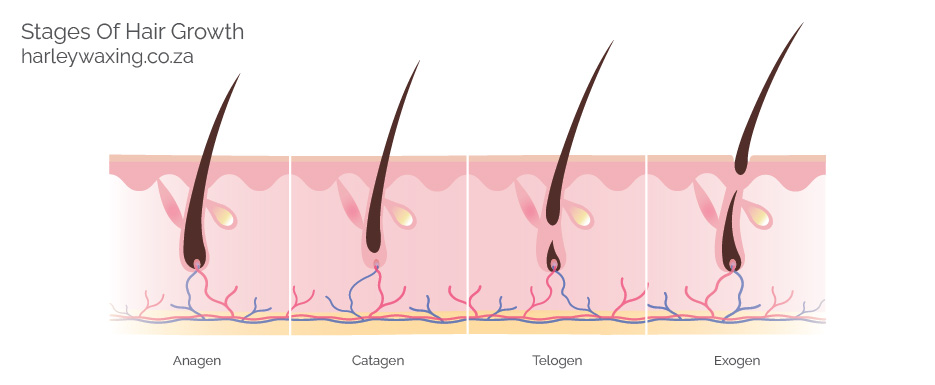
Anagen is the active growing phase. The dermal papilla supplies nutrient-rich blood to the hair bulb, which is thick and fleshy at this time and continuously produces new cells to form a hair. The Anagen phase for body hair lasts around 30 – 45 days (4-6 weeks), whereas the scalp can have 2-6 years of active growth. That’s why the hair on our heads gets much longer than body hair!
In the transitional Catagen phase, active growth winds down, and hair starts to separate from the follicle to enter a resting phase.
During the Telogen stage, the hair is still in the follicle but has detached from it and is no longer receiving any nutrients.
Exogen phase is when hair is shed to be replaced by new growth as the cycle continues.
Because hair follicles lie below the skin’s surface, trimming or shaving will not alter the hair growth cycle. It simply cuts off the hair. Waxing, however, can affect the hair growth cycle because hair is pulled out from the root. During Anagen phase, this will interrupt the blood supply and damage the hair bulb. Any active growth is reset and has to start anew. Doing this repeatedly eventually slows down and lessens hair growth. When hair is in any of the other growth stages, there is no active cell division in the hair bulb, so it is preferable to wax when hair is in Anagen phase.
Waxing regularly and consistently synchronises hair growth cycles and inhibits regrowth over time. When most of the follicles are in Anagen phase, it enables us to weaken more bulbs at the same time, and the hair will take longer to grow back. Over time, some hairs will stop regenerating entirely.
Creating this synchronicity between the growth stages takes time and requires multiple waxing treatments. It can take between 12 and 18 months for hair growth cycles to align, so consistency is key.
As with many other things involving the human body, it varies. A 4 to 6-week cycle is recommended to have as many hairs as possible in the active growth stage at every session. Hair may be too short very early in the Anagen phase, so best wait until it’s grown back properly (~5mm) before waxing again. Consistently waxing and not shaving in between sessions eventually synchronises the growth cycles.
Do not be tempted to stop waxing in winter. Not maintaining a regular waxing schedule will let growth stages fall out of sync again. Then, when summer comes around, the whole process has to be restarted. Keeping up with your waxing schedule, even during winter, will help you stay smooth and hair-free for longer when it really matters.
Using good-quality products will go a long way towards achieving the best results. Harley Waxing products are manufactured to high standards, using only the best ingredients. Our formulations are kind to skin, while retaining their efficacy.
Using the correct type of Harley Wax and applying the appropriate Pre- and Post-Waxing Products are essential to ensure complete hair removal and cared-for skin. Coarse, thick hair equals strong roots and can be challenging to remove. Harley Gold Strip Wax and Film Waxes were specifically designed to manage this hair type. Extra strong grip on hair reduces breakage while providing a clean removal.
Pre-waxing products prepare skin and hair for the most effective waxing treatment. Cleanser & Toner removes any impurities or oil and rebalances the skin’s PH level for optimal wax efficacy. Applying a small amount of Pre-Waxing Oil before using Hot or Film waxes coats the skin with a fine layer of oil. This creates a lipid barrier, enabling wax to adhere to only the hair and not the skin.
After-wax products have soothing, healing formulations to condition the skin, reducing irritation and redness. Healthy, calm skin is also less likely to develop ingrown hairs. Harley After Wax Oil contains Tea Tree and Lavender oils to assist in calming and healing skin after waxing. Aloe Soothing Gel’s Aloe Vera formula is moisturising, healing and soothing, giving a non-greasy finish with a fresh, cool feel.
Properly timing waxing treatments synchronises the hair growth cycles to ensure a smoother feel for longer, and eventually, regrowth becomes finer and sparser. Good-quality products and sound technique remove hair efficiently and support skin health for optimal results.